The Price of Power by Seymour Hersh
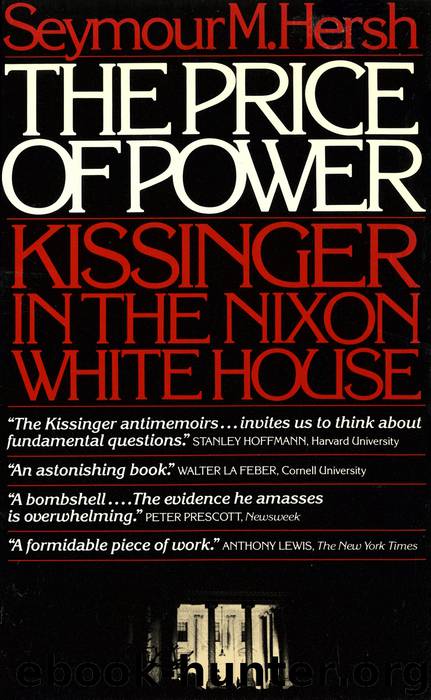
Author:Seymour Hersh
Language: eng
Format: epub
Publisher: Simon & Schuster
* * *
I. Although its ambassadors were withdrawn, China kept the embassies open where possible. The ambassador who stayed on the job was Huang Hua, who later became Ambassador to Canada. Huang Hua emerged as the spokesman for China after it was voted a seat at the United Nations in late 1971, and in 1976 he became China’s Foreign Minister, serving until his retirement in 1982.
II. A 1977 Rand study of Chinese foreign policy, prepared for the Pentagon, concluded that Mao deliberately held back from the internal feuding of the late 1960s, giving the impression to some scholars that he was “little more than a powerless shuttlecock bouncing back and forth between rival factions. . . . We would argue,” the study added, “that a more accurate representation would have Mao as the arbiter among various leadership factions—simultaneously manipulating the debate by seemingly throwing his support first with one group and then another. . . . In this manner, Mao cannily awaited the appropriate moment before fully revealing his hand.” The truth seems to be that no one really knows where Mao stood.
III. Quoted from “Chinese Foreign Policy Factionalism and the Origins of the Strategic Triangle,” by Thomas M. Gottlieb, an unclassified report prepared in November 1977 by Rand for the Director of Net Assessment, Office of the Secretary of Defense.
IV. Nixon reacted to the Soviet recognition of the PRG by instructing Kissinger to find a way to give a direct signal of American interest in rapprochement with China. Such requests would normally have been discussed with Morton Halperin, who had written widely on China and its policies toward the West. But Halperin was already a marked man in the White House, and could not be allowed to handle such a sensitive issue. Instead, Kissinger turned to Elliot Richardson, who was ordered to develop a series of proposals for relaxing trade controls. Halperin learned of Kissinger’s request immediately, for one of Richardson’s deputies promptly telephoned him, among others, to ask for advice.
V. The necessity for a change in American policy toward China was clearly felt throughout the academic community. As early as November 6, 1968, the day after Nixon’s election, eight prominent China scholars from Harvard University, Columbia University, and the Massachusetts Institute of Technology drafted a memorandum for the President-elect urging his administration to “move more positively toward the relaxation of tensions between China and the eventual achievement of reconciliation.” The group, chaired by Professor Jerome A. Cohen, a professor of law at Harvard, urged, among other moves, sending an emissary to meet in secret with the Chinese to discuss prospects for a normal relationship. In February 1969, some members of the group met with Nixon and Kissinger at the White House, but of course none was included or consulted when the American-Chinese contacts began. “Henry didn’t give much of a clue as to his thinking,” A. Doak Barnett, one of the group, recalls.
VI. American intelligence officials believe that the Chinese Communists were among the pioneers in electronic intelligence gathering, having developed a capability to intercept signals by the early 1930s.
Download
This site does not store any files on its server. We only index and link to content provided by other sites. Please contact the content providers to delete copyright contents if any and email us, we'll remove relevant links or contents immediately.
| Anthropology | Archaeology |
| Philosophy | Politics & Government |
| Social Sciences | Sociology |
| Women's Studies |
The Secret History by Donna Tartt(19105)
The Social Justice Warrior Handbook by Lisa De Pasquale(12197)
Thirteen Reasons Why by Jay Asher(8921)
This Is How You Lose Her by Junot Diaz(6894)
Weapons of Math Destruction by Cathy O'Neil(6285)
Zero to One by Peter Thiel(5808)
Beartown by Fredrik Backman(5768)
The Myth of the Strong Leader by Archie Brown(5513)
The Fire Next Time by James Baldwin(5454)
How Democracies Die by Steven Levitsky & Daniel Ziblatt(5225)
Promise Me, Dad by Joe Biden(5157)
Stone's Rules by Roger Stone(5091)
A Higher Loyalty: Truth, Lies, and Leadership by James Comey(4967)
100 Deadly Skills by Clint Emerson(4932)
Rise and Kill First by Ronen Bergman(4797)
Secrecy World by Jake Bernstein(4756)
The David Icke Guide to the Global Conspiracy (and how to end it) by David Icke(4724)
The Farm by Tom Rob Smith(4517)
The Doomsday Machine by Daniel Ellsberg(4493)
